

My approach to UX and Design Program Management grew out of a career in traditional design, consultancy, and agency environments. Formally educated in graphic design with a focus on computer graphics, I gained early exposure to television and film production before working within global events and staging companies. These experiences taught me that success in high-pressure environments depends on thoughtful collaboration, agreed ways of working, and a shared commitment to quality. Establishing pioneering design studios to support emerging technologies meant balancing multiple clients and competing priorities, building workflows, managing budgets, and delivering against deadlines. I learned early that process provides a critical foundation for coordinating the moving parts and delivering quality solutions for clients including Apple, Microsoft, Hyundai, Land Rover, Disney, Sydney Casino, and investment banks.

When I joined Microsoft’s Advanced Technology Group within its Australian subsidiary, I brought these foundational practices with me. Originally hired as an Art Director for a product already in development, I was given responsibility for leading the entire team and shipping the product just a few weeks later. That experience broadened my focus from the quality of individual design deliverables to the conditions needed for the whole team to succeed. I began to see beyond individual functions and understand the team as a working ecosystem. The responsibility challenged my leadership, but with the guidance of seasoned Microsoft veterans and mentors, alongside the dedication of our team, we successfully delivered three high-quality, award-winning children’s educational products on time and on budget.
After transferring to Microsoft’s main campus, my work shifted toward advocating for UX within an environment largely shaped by traditional engineering methods. I helped introduce user-centered design practices and service design perspectives, connecting user needs with business objectives. This approach was informed by my marketing studies at Macquarie University’s Macquarie Graduate School of Management and is being further explored through my current MBA studies at the Australian Institute of Business.
My work as a Principal UX Designer across Microsoft Business Planner, Microsoft Project, and Microsoft SharePoint deepened my understanding of enterprise collaboration and how organizations plan, coordinate, and deliver work. Designing for professional project managers, Project Management Offices (PMOs), and the teams they supported required extensive research into the relationships between portfolio oversight, project planning, and everyday collaboration.
At Microsoft Project, I helped drive the design of timeline functionality, contributing to a patent titled “System for Creating a Timeline.” This work explored how complex project information could be presented in a clearer, more accessible visual form, helping people understand schedules, communicate milestones, and align around a shared plan.
Our research also helped inform the group’s longer-term vision for more dynamic, distributed project management: moving beyond a centralized, hub-and-spoke model toward approaches in which teams could contribute directly, share ownership, and adapt plans as work evolved. Similar principles are visible today in cloud-based collaboration tools such as Microsoft Teams, Monday.com, and Asana. The experience reinforced my belief that effective tools and processes must reflect how people actually work while connecting team autonomy with organizational accountability.
Entering the demanding environment of Amazon’s Digital Products Group, I brought clearer definition to the UX Program Management role and its responsibilities within a fast-paced, metrics-driven organization spanning devices, platforms, and interconnected teams. Establishing shared expectations, delivery milestones, and reporting practices helped strengthen trust and confidence in the UX function while supporting the delivery of multiple device portfolios across successive generations.
Across these environments, I learned that teams and individuals need different kinds of support and leadership. A framework that brings clarity to one team can create friction for another. I draw on Design Thinking practices associated with IDEO and Stanford to understand the people, goals, dependencies, and constraints; identify where coordination breaks down; and develop, test, and refine an approach with the team. The aim is to establish enough structure to create alignment and accountability, with enough flexibility to adapt as the team finds its rhythm and delivers better products.
I’m sometimes asked why, with a design background, I enjoy working in an operational capacity. For me, it is an extension of the same craft. I think in systems: the team, its goals, its relationships, and its workflow form an interconnected ecosystem that can be designed and improved. Finding that rhythm is my design problem. When a team finds it—when people have clarity, speak the same language, bridge the gaps between functions, and channel their energy into focused, collaborative work—it is a beautiful thing.
UX Program Manager Responsibilities
Amazon Digital Devices Group
Amazon Digital Devices Group
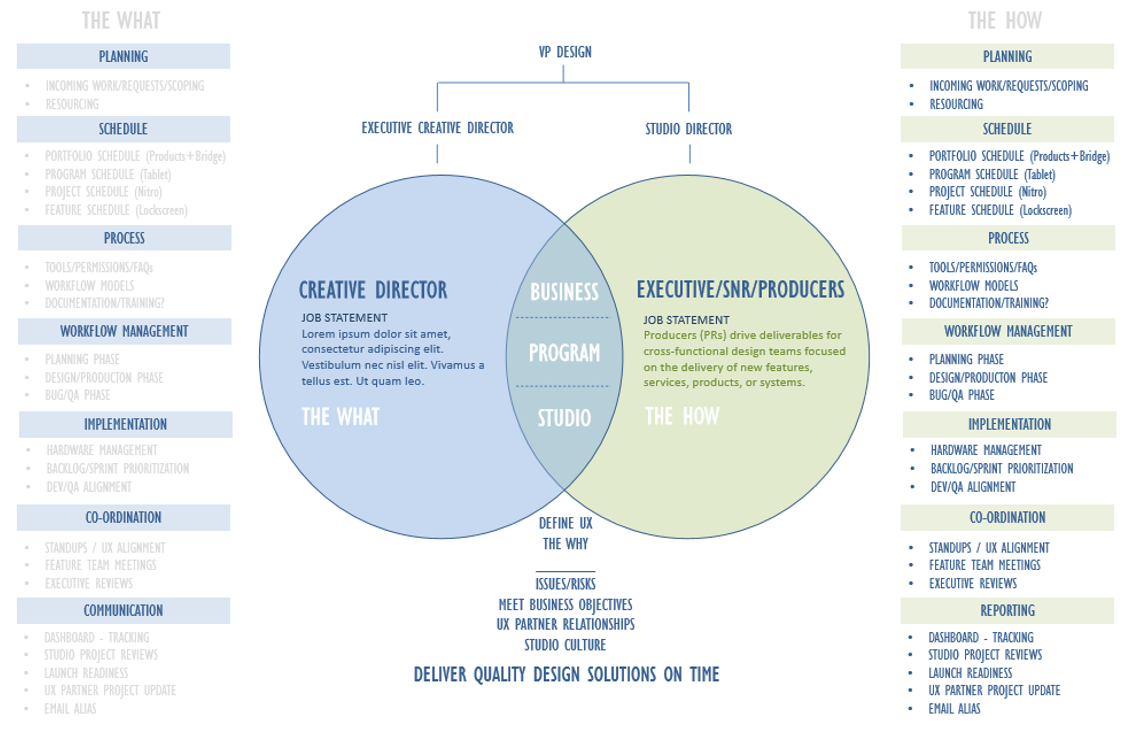
This Venn diagram communicates the shared responsibility between Design—the “what”—and UX Program Management, known at Amazon as UX Producer a carryover from a XBOX game producer —the “how.” As a manager leading a small team, I wanted to clarify responsibilities and shift the perception that Producers simply took notes and arranged meetings. They also needed accountability for delivering quality on time, supported by ownership of decisions that could affect that mission.
Owning the “how” did not mean dictating how designers worked. We started with established practices such as Design Thinking, then developed workflows and operating procedures through close collaboration with the people they would support. The goal was shared understanding, practical support, and commitment from the team.
Planning and Approach
Microsoft OneCare
This diagram reflects an earlier development model, when products were often “skinned” late in the cycle. The Core Windows VXD team translated Marketing, Packaging, and Brand direction into visual guidance for product teams to follow. I created the diagram to help OneCare’s security-focused team, whose program managers had limited UX and visual design experience, understand the workflow, anticipate dependencies, and build confidence in the approach.

Resource Management and Recruiting Examples
Aligning resources to priorities.
These examples illustrate my approach to recruiting and resource management. At UiPath, I adapted an Amazon resource planning template to show how a centralized UX team would support the product portfolio The tables clarified staffing needs, aligned resources with business priorities, and supported headcount conversion discussions. At Microsoft HoloLens, I led a critical 15-person resourcing initiative, restructuring existing vendor arrangements and contracts. I also managed vendors and agencies for the Windows studio, aligning capabilities, budgets, and staffing with delivery needs.

Program Schedule Example
Amazon Digital Devices Group - Kindle Fire Tables
Amazon Digital Devices Group - Kindle Fire Tables
This Kindle Fire tablet UX and product schedule gave teams a shared view of the path to delivery. My use of visual timelines began while leading Microsoft Kids, where I displayed end-to-end schedules on the wall. Later, my UX research for Microsoft Project reinforced their value: task lists and dates alone made it difficult for people to understand duration, progress, and alignment across workstreams.
This schedule connected our milestone definitions to different workflows, combining Design Thinking for feature UX with Agile sprints within a fixed release plan—a hybrid “Wagile” approach. Working backward from launch exposed the compressed delivery window and made the downstream impact of upstream decisions clear.
I carried a smaller version into planning discussions and reviews to quickly assess changes against dependencies and the release glidepath. It helped guide daily decisions and built executive confidence that UX remained focused on delivery.

Milestone Definitions
Amazon Digital Devices Group - Kindle Fire Tables Team
Amazon Digital Devices Group - Kindle Fire Tables Team
When I transitioned to this studio the UX team was not consistently meeting delivery commitments and slipping design schedules were affecting Engineering and partner teams that depended on their work. Amazon’s traffic-light status reporting made these dependencies highly visible: teams marked as red, or blocked, frequently pointed to outstanding UX deliverables as the cause. This contributed to a culture of finger-pointing and blame, while the team’s working rhythm remained centered on ideation and executive reviews, without a consistent understanding of milestone expectations or when design needed to be ready. The tablet portfolio had a fixed delivery window, with manufacturing, packaging, and go-to-market activities working backward from the critical holiday sales period. Drawing on my experience shipping children’s CD-ROM products with similar dependencies, I recognized the need to connect ongoing design iteration to clear delivery commitments and protect time to integrate, validate, and resolve issues before launch.
I introduced industry-standard milestones as a starting point, then worked collaboratively with the UX team to develop definitions they understood, believed in, and could commit to. Once agreed, the framework became a studio poster and was embedded in JIRA, schedules, and project health scorecards. Consistent language and reporting helped build momentum, and the milestones were subsequently adopted across other studio products and extended to first-, second-, and third-party applications developed for the tablet.
The goal was to connect a long-term release glidepath with meaningful near-term commitments, giving every team member a target date and a shared understanding of what “done” meant. Dates could be adjusted as circumstances changed, but explicit commitments gave the team a sense of time and accountability—guiding daily decisions, exposing risks earlier, and keeping the work moving toward launch.

Design Thinking - User Centered Design
Carnival Cruises - Medalion Program - Wayfinding
Carnival Cruises - Medalion Program - Wayfinding
My commitment to Design Thinking and user-centered design is grounded in balancing user needs with business objectives. Early in my career, designing products for children aged two to five, who would literally cry when an experience became frustrating, anchored me in usability, observation, and adapting to user feedback.
I have since joined initiatives where these fundamentals had received too little attention, and the solutions were falling short. On one cruise wayfinding program, the initial direction emphasized a cinematic 3D experience, reportedly inspired by Titanic. Without coherent design direction across organizations, I spoke up to help reset the approach around users’ goals, tasks, and environments. The broader portfolio surfaced many of the same needs and design principles I had identified during pioneering work with Microsoft’s Connected Home of the Future team: consistent experiences across devices, interactions suited to each setting, and technology that supports people’s everyday needs.
We established daily cross-functional design critiques and walked the group through Design Thinking, building a shared understanding of the problems we needed to solve. Alongside the 3D experience already pitched to the client and resourced, we developed a more usable solution across devices and settings, including a stateroom monitor operated by remote control. Grounded in these fundamentals, the team rallied and became one of the few workstreams to deliver within the broader program. Those solutions continue to operate across the fleet today.
Design Thinking IXDF Certification

Motion and Visual Design Scheduling
Amazon Digital Products Group
I usually manage motion and visual design through a separate schedule aligned with the master program timeline, using a structured workflow to capture core design work and requests from UX feature teams. Visual assets can often be integrated later in development, allowing a different delivery cadence. With dedicated reviews and tracking, the visual design and production squad stays focused on its priorities and dependencies without being overwhelmed by the broader program.

Studio Operating Principles
Creating a culture for success
These Studio Operating Principles have taken shape over my career, through hands-on design, creative production, and leading UX teams across different organizations. I have seen talented teams struggle when expectations were unclear, and watched them thrive when shared understanding, trust, and accountability were in place. These are the principles I have come to rely on when establishing or strengthening a studio: a common foundation for collaboration that respects creative freedom while recognizing the commitments and dependencies of delivering a product. They reflect my belief that creating the conditions for people to do their best work is essential to delivering quality, on time.
Operational Principles
1. Consistent Language
Establish shared definitions for milestones, deliverables, and project health so everyone understands what is expected and what “done” means.
Establish shared definitions for milestones, deliverables, and project health so everyone understands what is expected and what “done” means.
2. A Sense of Time
Make room for exploration while understanding deadlines, dependencies, and the impact our decisions have on others, especially our engineers.
Make room for exploration while understanding deadlines, dependencies, and the impact our decisions have on others, especially our engineers.
3. Commitment to Quality
Agree on the quality bar, validate against user needs and business goals, and take ownership of carrying design intent through delivery.
Agree on the quality bar, validate against user needs and business goals, and take ownership of carrying design intent through delivery.
4. Clear and Transparent Communication
Share progress, decisions, and risks openly. Raise concerns early enough for the team to act and adjust.
Share progress, decisions, and risks openly. Raise concerns early enough for the team to act and adjust.
5. Trust in the Squad
Respect each person’s expertise, encourage constructive challenge, and give people the autonomy and support to own their commitments.
Respect each person’s expertise, encourage constructive challenge, and give people the autonomy and support to own their commitments.
Tool Management and Configuration
Connecting creative work to confident delivery
Connecting creative work to confident delivery
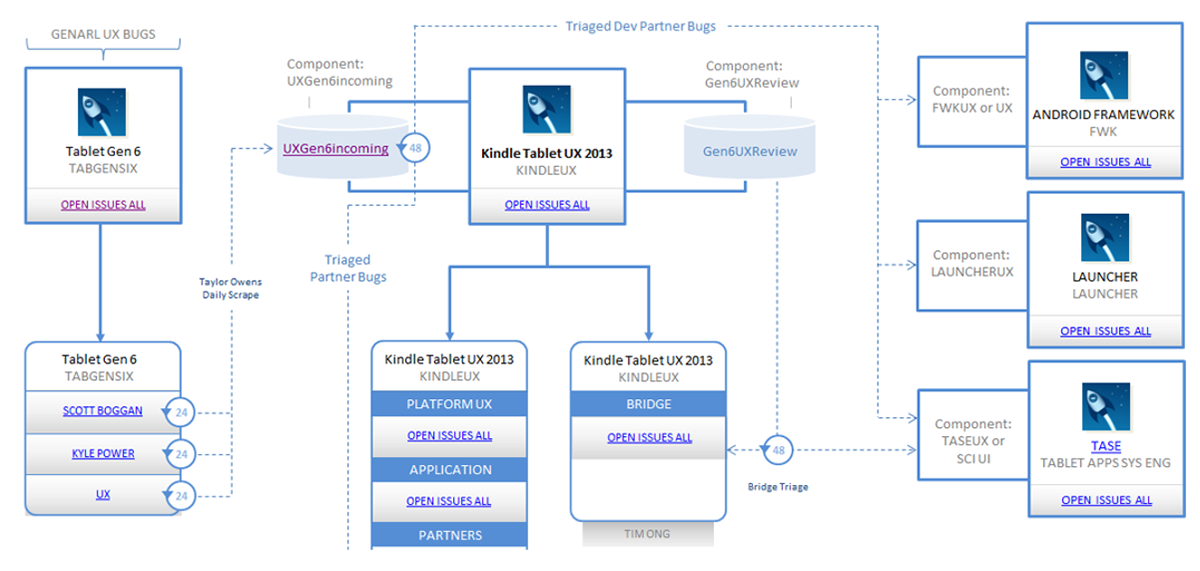
When I joined Amazon’s Digital Products Group, teams were using Atlassian Confluence for basic to-do lists and status tracking. To manage the complexity of multiple devices and workstreams, I introduced Jira and configured its workflows around Design Thinking and UX practices. Saved queries provided visibility at the click of a button—from a critical feature moving through review and integration to a single icon asset.
I call this “engineering the design process”: building the structure to support creative work, surface dependencies, and track delivery. Adoption took time, as many UX practitioners were unfamiliar with these tools. My approach drew on earlier children’s software development, where robust tracking helped coordinate thousands of design, animation, and audio assets.
My fascination with project management and collaboration continues today. I regularly explore tools such as Asana, Airtable, Upclick, Notion and Monday.com, evaluating how they can simplify coordination and create more room for teams to focus on design.
Consolidating Design Tools. Connecting Teams.
Building the foundation for shared workflows and a scalable design system.
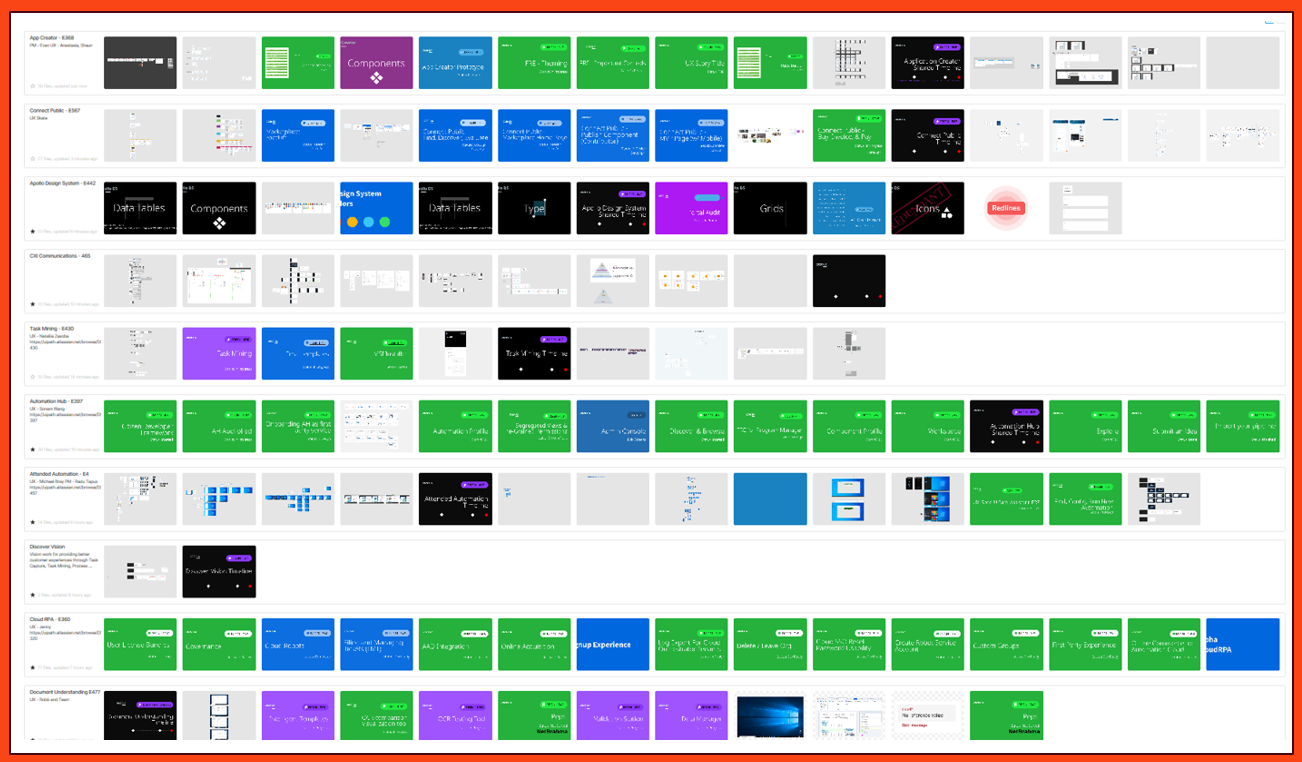
Before establishing a shared design system at UiPath, I needed to bring globally distributed studios and individual designers onto a common toolset. Teams were working across different applications, creating friction in collaboration, file sharing, and handoffs. After researching the options and recognizing the broader market shift toward Figma, I built the business case for leadership and stakeholders, outlining the return on investment through consolidated licensing, reduced duplication, and more efficient workflows.
Gaining buy-in meant connecting those benefits to teams’ everyday needs. I coordinated deployment, migration, and onboarding, while establishing account administration, license allocation, and payment management. Within Figma, I introduced consistent file structures and thumbnails that provided lightweight, high-level status at a glance. Linking design work to Jira Epics and Stories connected it to our Design Thinking workflow, making ownership, progress, and dependencies easier to follow. This foundation supported the next step: a shared design system that teams could build, maintain, and adopt together.
Tracking, Reporting and Scorecards
Calling balls and strikes
Calling balls and strikes
I have created and presented status reports to leadership since the beginning of my career. At Amazon, strong mentorship sharpened my approach, teaching me the rigor and detail expected across business performance, productivity, and effectiveness goals. I brought that discipline to the Digital Products Group and later back to Microsoft with HoloLens, using project health reports and executive scorecards to connect design readiness, resources, dependencies, and risks to delivery milestones.
Effective reporting depends on shared agreement about what project health means and a willingness to call balls and strikes. Labeling everything green may feel advantageous, but it removes the opportunity to act before problems escalate. I advocate for honest, transparent reporting that makes risk visible early, giving stakeholders time to adjust priorities, resolve dependencies, or provide support.
For me, scorecards turn visibility into action. Clear ownership agreed success criteria, and a consistent review cadence help teams make informed trade-offs, stay accountable, and build confidence through a realistic view of progress.


Executive UX Program Communication
Clear options. Understood risks. Confidence to deliver.
I prepared this one-page brief for David Limp, then SVP of Amazon’s Digital Products Group, reporting to Jeff Bezos, to clarify the UX implications of several proposed lockdown dates. It outlined the delivery options, risks, dependencies, and trade-offs for each scenario, giving stakeholders a clear view of what UX could commit to delivering. By making the assumptions and execution plans explicit, the brief built confidence that we understood the impact of each option and were prepared to execute against the chosen timeline.

Executive review in an enterprise model
Connecting design intent with executive decisions.
At Amazon, I coordinated executive design reviews with senior leadership, including CEO Jeff Bezos, connecting design preparation with clear decisions and follow-through. Working with Jeff’s preference for printed content, I evolved the reviews to also include experiences on the devices themselves, where form factor, screen size, designing with light, and interaction were essential to obtaining nuanced feedback. I advocated for younger, less experienced designers to “be in the room,” giving them exposure to executive communication and decision-making, including discussions that could become tense. I helped designers prepare their pitches, sharpen their rationale, and anticipate questions, then supported them during reviews by prompting conversations and bridging communication gaps. After each review, I captured decisions, clarified ownership, and translated feedback into tracked actions in our workflow system, ensuring nothing was lost between the executive discussion and delivery.

Change Management
Creating stability without closing the door to change.
At Amazon, the development manager responsible for shared design system controls across devices approached me frustrated by constant design churn, unclear schedules, and visual exploration driven by available capacity rather than delivery priorities. With tablets now scheduled to launch ahead of phones, leadership had placed design delivery under my remit. He asked for a change management process—something he had reportedly been requesting for over a year. I committed to delivering it within two days. We shook on it, shared a little humor about his skepticism, and I delivered.
The process established me as the central point for reviewing changes and assessing their impact on quality, dependencies, and delivery commitments. As the holiday release approached, I kept the visual design team focused on agreed priorities, and no change requests came through the pipeline. Necessary changes were still welcome; the team simply understood the expectations and took ownership of meeting them. The process reinforced our culture: quality, on time.

Connecting Discovery to Delivery
Aligning UX decisions, working software, and client confidence.
Aligning UX decisions, working software, and client confidence.
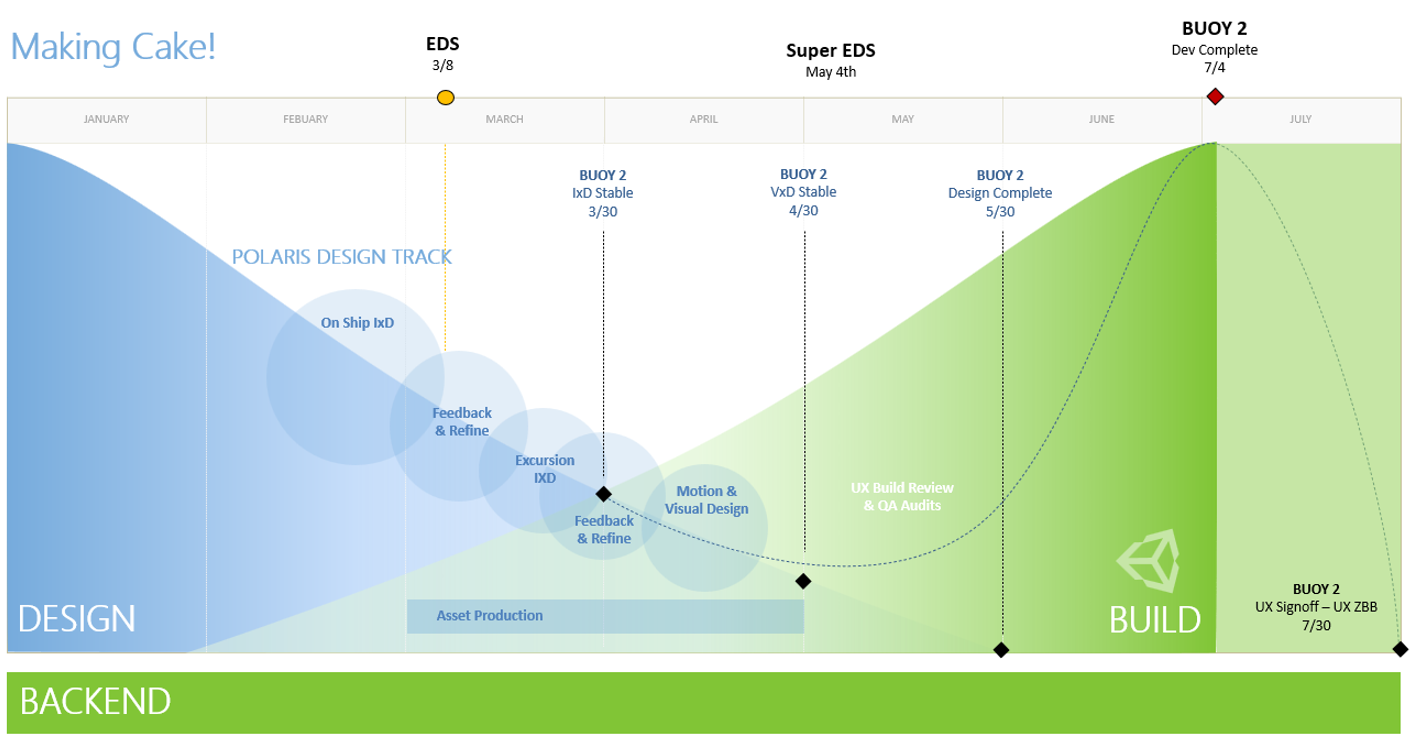
With the program behind schedule and tickets already sold, the client faced a fixed launch date and complex hardware dependencies. Relatively new to software development, they had adopted Agile without clearly defining an MVP. Their preference for reviewing only working code reflected the Agile Manifesto’s emphasis on working software, but left UX teams needing feedback on discovery and requirements.
I introduced reviews spanning multiple workstreams and stages, connecting early UX decisions to a clear implementation timeline. We presented designs on their intended devices and closed with an engineer demonstrating working code. This maintained client engagement in design reviews and approvals, built confidence in our delivery approach, and prompted them to request the same method from other consultancies. The "making cake" phrase was a term the client liked to use to describe product development. Buoy to replace Beta was also a client directive.

Organizational Workflow Design
Unity Design System Proposal
Unity Design System Proposal
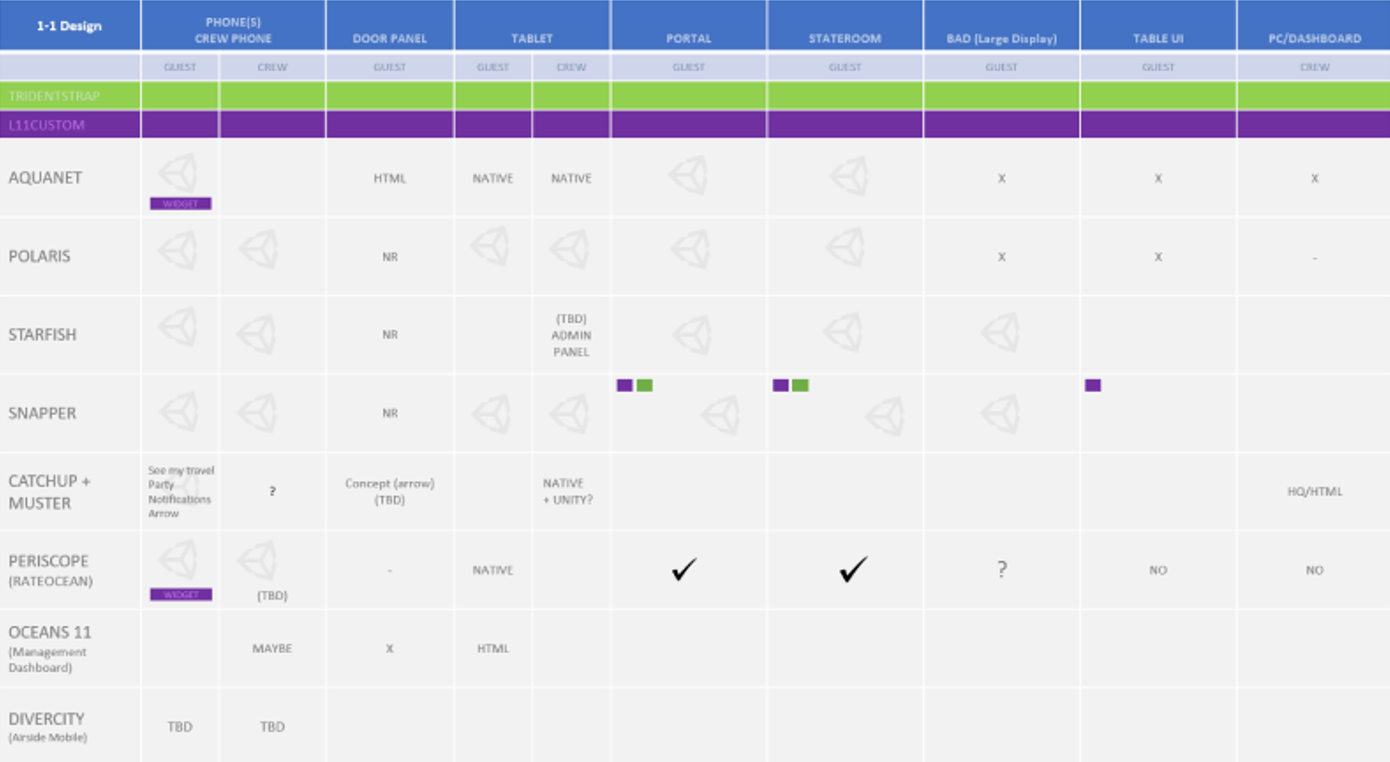
Carnival’s Medallion Experience, code-named Trident, set out to bring the connected guest experience pioneered in Disney’s theme parks to its fleet of cruise lines. This ambitious program brought together internal teams and external partners to connect digital services with the physical ship environment. The consultancy I worked with was developing sensing devices to detect guests’ Medallions as they moved around the ship. This company picked up a number of experiences to such as the Wayfinding experience.
When Carnival selected Unity as its development platform, I identified an opportunity for our company to lead a shared design system of reusable controls and interaction patterns. Drawing on my Unity experience from HoloLens and recognizing the shortage of specialist skills, I proposed a centralized capability to support UX feature teams, improve consistency, and reduce duplicated effort across the program.
The first diagram explores how our UX feature teams could collaborate around this shared foundation. The second and third outlines how work could be coordinated, managed, and tracked to support delivery.


Design Systems
Built for consistency. Designed to evolve.
Design system teams can be structured and positioned in many ways, with responsibility driven by roles in Design Leadership, UX Program Management, or a partnership across disciplines. As AI-generated content and interfaces become more prevalent, design systems provide a critical foundation for consistency, accessibility, and quality.
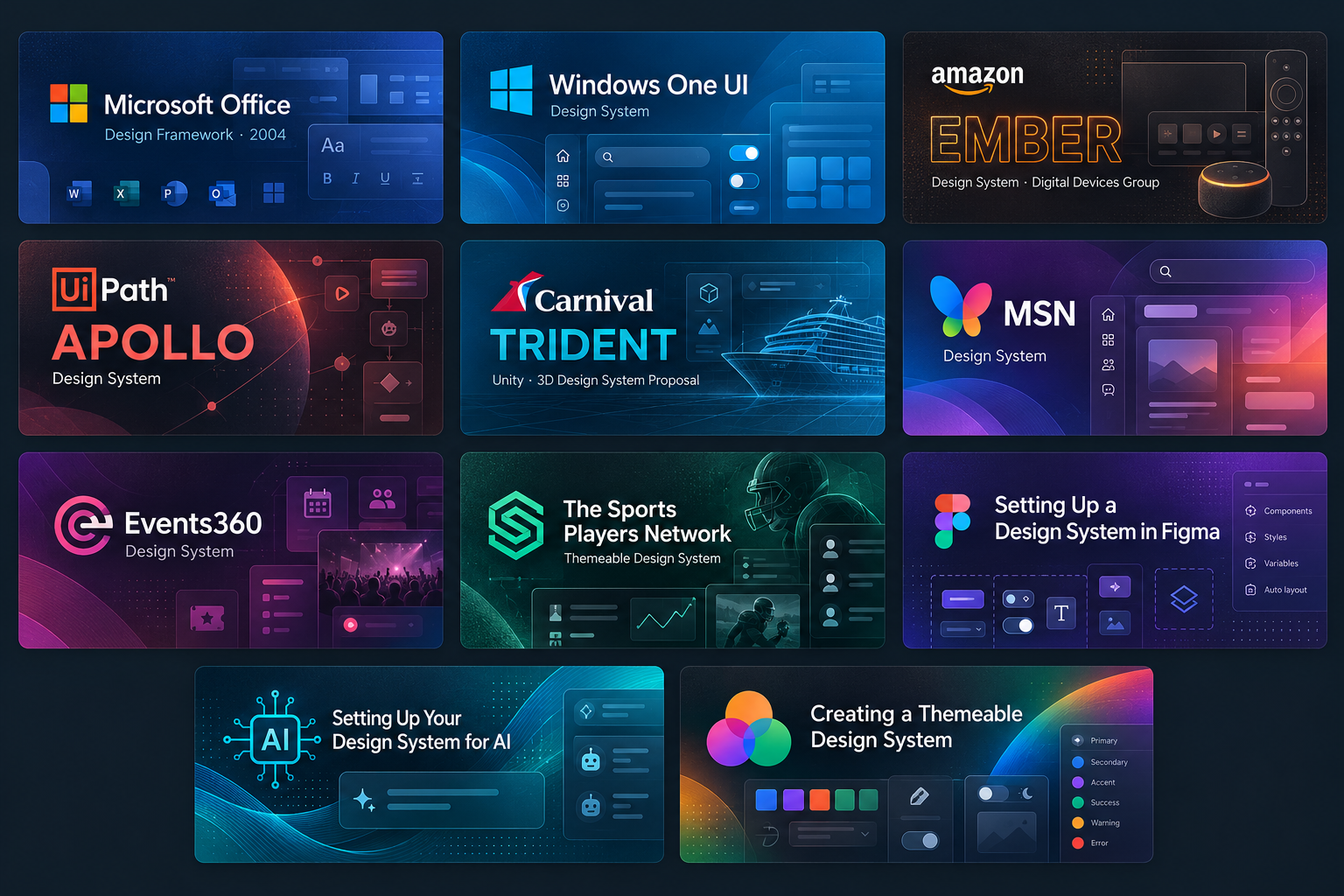
My design systems experience spans early foundational thinking at Microsoft through to leading systems across devices, platforms, and global teams. In 2004, I proposed a structured design framework for Microsoft Office—before Figma and today’s design token conventions—as the group took early steps toward cloud-based delivery. I presented the approach to Office leadership in 2005 and later returned to Microsoft to help drive Windows One UI v1, which evolved into the Fluent Design System.
At Amazon, as Executive UX Producer/Program Manager, I led the Ember v1 Design System across Fire Tablet, Fire TV, and Fire Phone, connecting shared controls and interaction patterns with engineering implementation and governance. As Head of Design Operations at UiPath, I led Apollo v1, aligning shared Figma component libraries with React and Angular implementations.
My experience also includes a proposal for Carnival’s Trident design system in Unity for 3D experiences, alongside work across MSN, Events360, and The Sports Players Network. For The Sports Players Network, I am exploring a themeable design model that supports multiple club affiliations while maintaining shared foundations and a consistent user experience.
Across these efforts, my focus has been on connecting design foundations, reusable components, accessibility, and contribution practices with the operating models' teams need to succeed. This means establishing ownership, aligning design and engineering priorities, supporting adoption, and creating feedback loops that help the system evolve with the products and people it serves.
AI in UX & Design Operations
Exploring new capabilities. Applying human judgment.
My interest in AI builds on a career-long fascination with how people, processes, and tools come together to support great design. Through ongoing study, certifications, MBA research, and hands-on experimentation, I am exploring how AI can support UX practice and reduce the operational effort surrounding it—from discovery and prototyping to documentation, reporting, and workflow automation.
AI in the design process
Supporting exploration, synthesis, prototyping, content, and evaluation, with human review and user validation.
Supporting exploration, synthesis, prototyping, content, and evaluation, with human review and user validation.
AI in studio operations
Exploring opportunities to simplify intake, reporting, documentation, knowledge retrieval, and repetitive coordination.
Exploring opportunities to simplify intake, reporting, documentation, knowledge retrieval, and repetitive coordination.
Learning into practice
Connecting coursework and research to experiments, artifacts, and lessons that inform how you work.
AI related certifications:
Connecting coursework and research to experiments, artifacts, and lessons that inform how you work.
AI related certifications:
UI Path Design Program Alignment
Shared visibility. Shared understanding - Turning a wall into a conversation
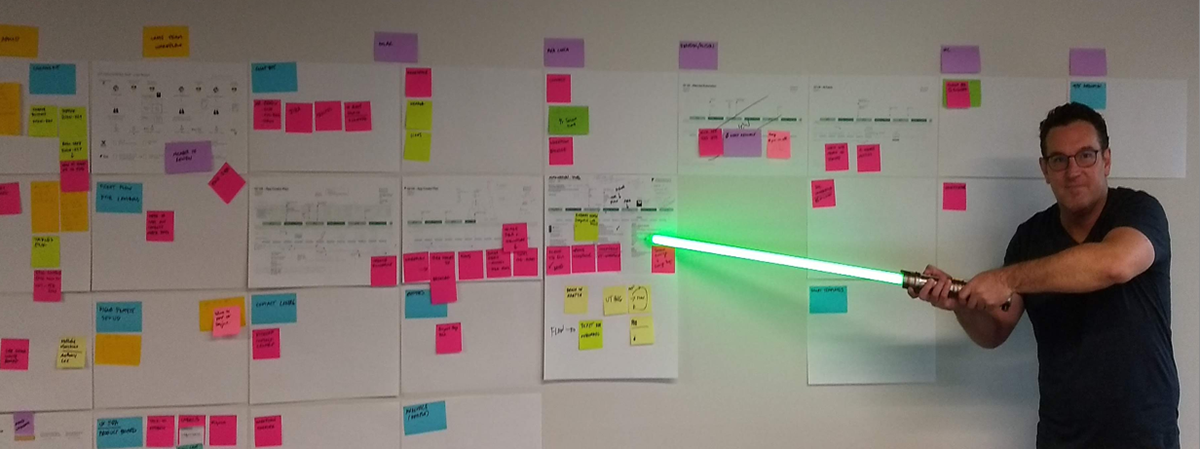
To build a shared understanding of the work across globally distributed partner teams, I turned a long studio wall in our Bellevue office into a visible, accessible program overview. Guided by my belief that “design is for walls, not closed doors,” I mapped team structures, roles, dependencies, partnerships, schedules, and outstanding tasks, highlighting open issues and blockers in pink. When partner VP visited from around the globe, the wall became a gathering place for leadership and cross-team conversations, bringing the work and its interdependencies into focus. All information was also maintained digitally, providing continuity when COVID moved us to remote work just days later.
Peer Feedback
Listening to peers, growing as a leader.
Understanding how others experience my leadership is an important part of improving how I support teams. The peer feedback gathered here offers perspectives on my approach to collaboration, communication, and delivery. I view these reflections through the principles of self-awareness, servant leadership, and continuous improvement: listening openly, understanding the impact of my actions, and identifying where I can better support others. Alongside my own reflection, these perspectives help me recognize strengths, challenge assumptions, and shape how I lead.


